

The Fujifilm Group Seven Actions for Good Health were introduced in 2020 and employees were called on to put them into practice, as it is important for employees to acquire a healthy lifestyle in order to prevent the occurrence and aggravation of problems such as lifestyle diseases, cancer, mental disorders and COVID-19 infection. We will regularly check the degree to which each of the Seven Actions for Good Health is practiced in order to improve the health level of the entire Group.
Weigh yourself once a week
Check your health check results
No alcohol once a week
6 hours sleep every day
30 min. walk every day
Paticipate in the walk event (“Arukatsu”)
No smoking
The implementation status of the “Seven Actions for Good Health” was verified in an e-learning questionnaire conducted in September 2025. We check the implementation status once a year.
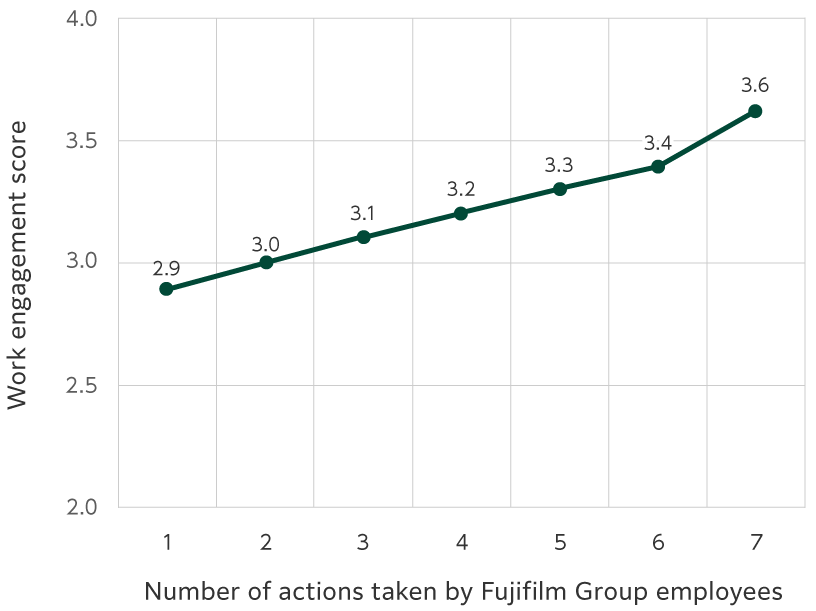
We found that there is positive correlation between the number of actions actually taken from the Seven Actions for Good Health, and the level of performance*1 and work engagement*2. We recommend employees to put these actions into practice in daily life.
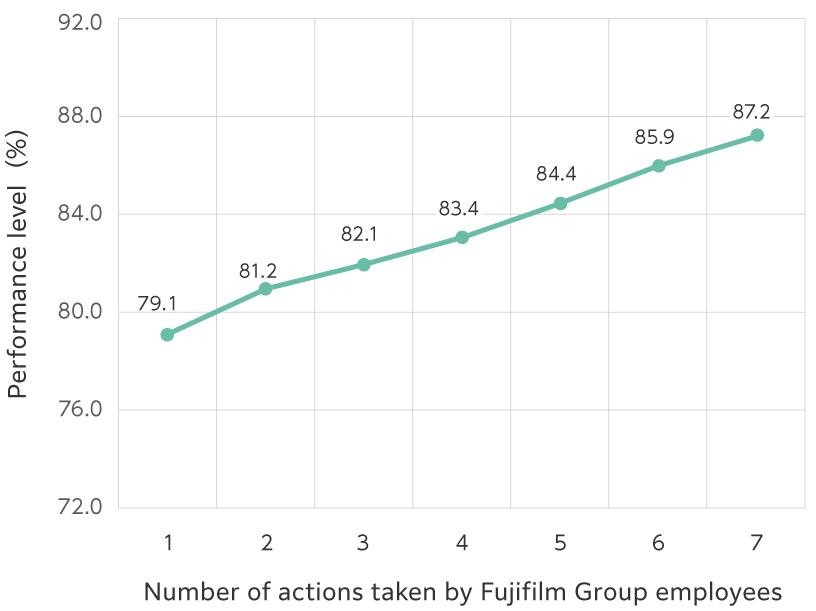
Fujifilm Group employees in Japan: 43,893, Results: FY2025
- *1 Level of performance: Employees assess their own work performance over the last four weeks compared to their 100% performance when they are free from illness or injury, using the Single-Item Presenteeism Questionnaire developed by the University of Tokyo.
- *2 Work engagement: Defined as the state where three aspects are fulfilled. (1) Feeling refreshed or obtaining energy from one’s work (vigor); (2) Feeling pride and a sense of satisfaction in one’s work (dedication); and (3) Devoting significant energy to one’s work (absorption). We measure this using the 3-item Utrecht Work Engagement Scale.
We have distributed posters and digital signage content for the “Seven Actions for Good Health” to our group companies in Japan and spread awareness among employees by displaying them in the workplace and showing them in cafeterias.
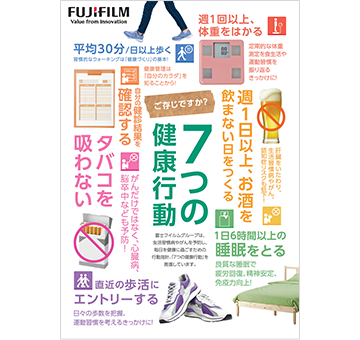
Seven actions for good health poster #1
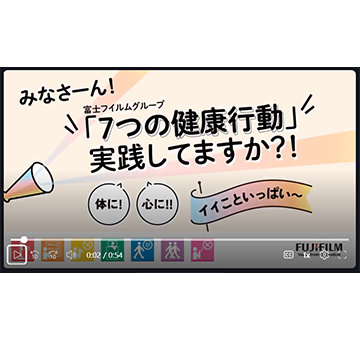
Seven actions for good health digital signages

Seven actions for good health poster #2
Content for Public Awareness


Since 2016, we have been hosting a biannual competition that sets up teams that compete for the highest average daily steps called, “Arukatsu.” This has led to behavioral changes of those who normally do not walk much. We are also seeing an increase in the number of participants.
From FY 2022, we have started the company competition co-sponsored by companies, health insurance association, and employee organizations (labor union/employee union). At the award ceremony, winning company is awarded a trophy.
Through competition of 38 domestic group companies with 30,000 participants (spring 2026), we are developing measures such as presenting a trophy to the winning company at an awards ceremony so that entire group employee can enjoy health promotion.

Each group company in Japan had its own measures and practices for lifestyle diseases, but since FY2019, Fujifilm has been sending letters in collaboration with Fujifilm Group Health Insurance Association to recommend a health checkup directly to the employee’s home for those group employees who are determined to be high-risk. Each company’s medical staff follows up to ensure that the employees receive medical consultation.
Regarding cancer prevention, we have offered cancer screening services to employees at the Fujifilm Health Management Center in Minami-Ashigara City, Kanagawa Prefecture. In addition, we established the Fujifilm Nishi-Azabu Medical Center at Fujifilm Nishi-Azabu Headquarters Building for cancer prevention and treatment in 2014.
The clinic uses endoscopic systems incorporating the company’s unique advanced technologies, including a transnasal endoscope that is inserted into the nose to reduce nausea caused by gag reflex, for its upper endoscopy services.
In April 2022, we opened FUJIFILM Mediterrace Yokohama, a medical clinic for Fujifilm Group Health Insurance Association members, in FUJIFILM Business Innovation Yokohama Minatomirai Center. The clinic is equipped with the Fujifilm’s latest endoscope and mammography systems, as well as an AI-driven medical IT system, enabling us to offer high-quality health checkup services. We started accepting people for full medical check-ups in June 2023, for CT scans in January 2024 for MRI scans in May 2025, and pancreatic cancer screenings in April 2026, chest and abdominal CT scans in July 2026, rolling them out in stages.
Moving forward, we strive to achieve the KPI which bring the domestic group employees ‘check-up rate to 90% for stomach cancer, large intestine cancer, breast cancer, and cervical cancer. We promote this initiative with our strong will to minimize the number of Group employees passing away from cancer by increasing the chances of early cancer detection and receiving appropriate treatment.

Fujifilm Health Management Center (Minami-Ashigara City, Kanagawa Prefecture)

Endoscopic Clinic, Fujifilm Nishi-Azabu Medical Center (Minato-ku, Tokyo)

FUJIFILM Mediterrace Yokohama (Yokohama City, Kanagawa Prefecture)
| Cancer Screening | Screening Method | Eligible Employees | Screening Interval |
|---|---|---|---|
| Stomach Esophagus |
Endoscopy (X-ray) | 35 years old and 40 or over | Every year |
| Colon | Fecal occult blood Colonoscopy |
35 years old and 40 or over 50 years old and over |
Once a year Once while employed |
| Breasts | Ultrasound (up to 39 years old) Mammography (from 40 years old) |
Female | Every year |
| Uterus | Cytodiagnosis | Female | Every year |
| Prostate | PSA (blood) | Men 50 or over | Every other year |
| Lung | Chest helical CT | 40 or over | Every year |
| Liver, kidney, pancreas, biliary tract | Ultrasound | 35 years old and 40 or over | Every year |
Assistance provided by Fujifilm Group Health Insurance Association (Average annual aid for people aged 40 or older: men 28,400 yen per person; women 40,600 yen per person)
We are promoting awareness and understanding of the importance of colonoscopy among employees, which has a high morbidity rate in Japan.
Those who have tested positive for the presence of fecal occult blood are encouraged to follow up with a colonoscopy and are kept track of by each of their company medical staff in Japan. We are also sending individual emails to employees aged over 50 years old to encourage them to undergo screenings, including offering a subsidy from the Fujifilm Group Health Insurance Association—limited to one time during their employment.
In FY2019 we hosted a lecture at our head office by Dr. Yokoyama, the director of Fujifilm Nishi-Azabu Endoscopic Clinic, entitled “Recommending Colonoscopy” which drew 165 participants. The video of this lecture is available on the company’s intranet to employees anywhere in Japan.
In FY2022, Dr. Yokoyama conducted an e-learning program for approximately 43,000 employees in the Fujifilm group to promote gastric and colorectal cancer screening. We have gained a better understanding of the importance of cancer screening and the importance of gastroscopy and colonoscopy screening, which has led to screening.
In order to increase the cancer screening rate, we have moved forward with offering a choice of testing organizations, adding screening to regular health checks, and conducting educational activities.
Since FY2023, a basic policy for gastric cancer screening has been based on the use of upper endoscopy (gastro endoscopy), which was explained at the Health Management Promotion Director Meeting. It was also posted on the “Wellness Portal Site” and made known to the entire Group to promote understanding and encourage medical checkups.
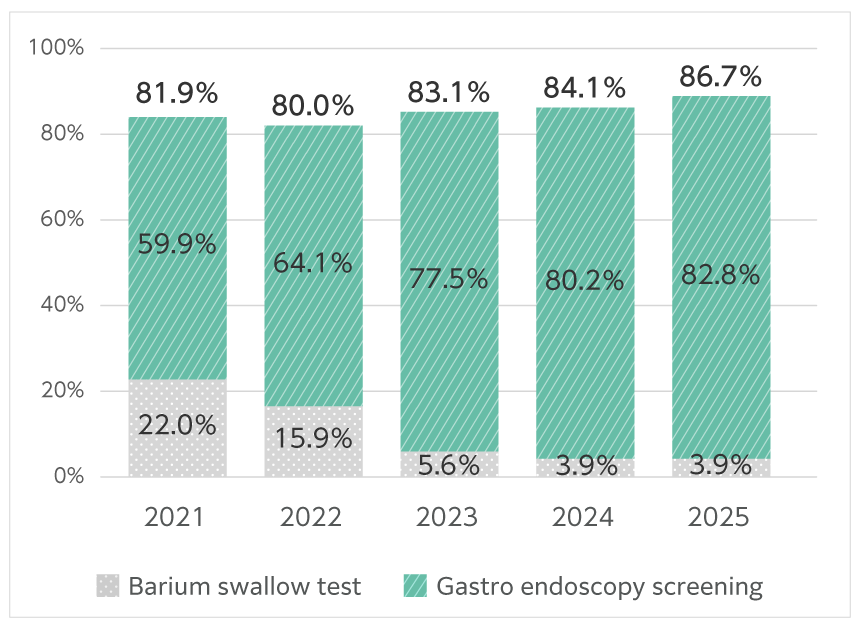
Group employees in Japan 40 or older
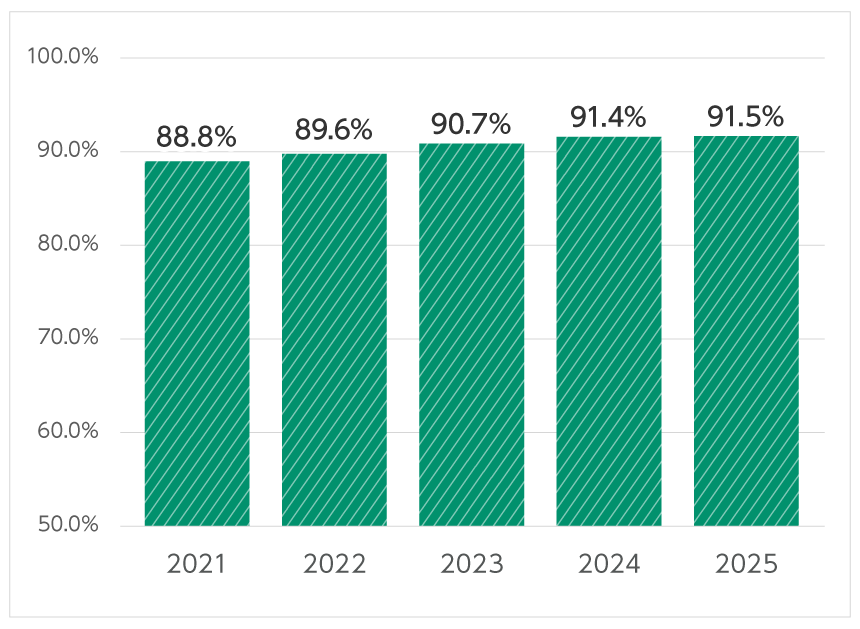
Group employees in Japan 40 or older
From FY2015, the entire domestic Group has been promoting smoking cessation during working hours. Starting in FY2019, we designated a non-smoking day once a month to create an environment for encouraging smokers to stop smoking.
Furthermore, in order to support smokers to quit smoking and to commit to preventing secondhand smoke in the company environment, we updated the Employment Regulations for all domestic Group companies to include a smoking ban during working hours and closed all smoking areas on company premises in Japan in October 2020. We have gained the understanding and cooperation of customers who visit the company, as well as that of partner companies on our premises.
- The health program operated in collaboration with the Fujifilm Group Health Insurance Association offers various types of programs to help employees stop smoking and provides support so those efforts progress smoothly.
- Online Smoking-cessation Program
It has been well-received as a program that busy employees can commit to easily and quit smoking reliably. Since the adoption of the Health Management Declaration in September 2019, 803 applicants (as of the end of September 2026) have applied to the Program with the goal of quitting cigarette smoking. - Distribution of free patches and Gum to employees to help quit smoking
A new measure started from FY2020. By lowering the hurdles, we are supporting the challenges associated with quitting cigarette smoking. Many employees took the first step to quitting smoking as 1,246 employees applied for nicotine patches (Equivalent to 5,000 yen per person), and 664 applied for nicotine gum (Equivalent to 6,000 yen per person).
- Online Smoking-cessation Program
- The Health Management Office in each business office also accepts smoking-cessation outpatients at any time.
In addition, we publish a series of success stories about executives quitting cigarette smoking on the company’s intranet and also publish feature articles on quitting cigarette smoking in the Group newsletters to cultivate a culture of non-smoking at all our Group companies.
In FY 2022, smoking cessation seminars were held by specialists at sites with high smoking rates, seminar videos were distributed to employees, and also posted on the “Health Portal Site” so that it could be viewed at any time. In FY 2023, the head of the Human Resources Department at FUJIFILM Holdings, who is responsible for health management for the entire Group, sent a letter to the presidents of each Group company in Japan, asking them to further accelerate their efforts to stop smoking, and to re-emphasize the Group policy.
In FY 2024, Health management promotion officers and representatives from each group company, the Health Insurance Association, and employee organizations (labor unions/employee associations) participated in team discussions to promote smoking prevention. Each company has formulated and implemented its own action plan, and in FY 2025, we began posting video lectures on the in-house intranet health portal site by specialists in public health and epidemiology—based on scientific evidence regarding the risks of heated tobacco products and secondhand smoke—and distributing them to employees.

Group employees in Japan
We conduct annual stress checks for all domestic group employees. Since FY 2021, each Group company in Japan has been conducting organizational analyses of stress check. Based on those results, we “diagnose” a workplace. For workplaces that present a high health risk, the company physicians and human resources department work collaboratively, first holding a workplace meeting, to analyze the causes, and then to create a plan to improve the work environment.
In addition, we have created a tool used across the group for employees to check themselves any time. In March 2023, a video for mental health self-care training explained by the Fujifilm Group mental health management physician (company physician) on an in-house health portal site, aiming to understand what stress is, become aware of stress, and understand the basic concepts of how to deal with stress, method on the perspectives and utilization of the results of stress check.
In June 2021, e-learning-based Line Care Training was provided for all group employees and managers in Japan.
At the start of the training, General Manager of the Human Resources Division, FUJIFILM Holdings Corporation, as the Employee Wellness Manager, commented on “the need to give consideration to and guidance on wellness to employees and particularly the importance of detailed management during the COVID-19 pandemic” as mental health is a priority employee health and wellness issue.
Then the Fujifilm Group mental health management physician (company physician) directly lectured the importance of mental health measures in the workplace and what kind of roles are required of managers based on his experience and knowledge. Numerous managers submitted comments that the training was useful, such as “I really learned that superiors play an important role in responding to subordinates” and “I want to be a superior that subordinates can seek advice from.”
We are promoting preventative initiatives throughout the group by implementing trainings using a manual on mental health management for all new executives.
In FY 2022, we established a mental health counseling service (telephone, Web and interview) and established a system that can be supported for 24 hours. In FY 2023, we implemented “resilience,” a program on how to build a mental strength that can withstand stress, and in FY 2024-2025, “mental health care: self-care (Knowledge and Practice)” as an e-learning program for all domestic employees.
The entire group uses a health checking system to prevent health problems caused by working excessively long hours. If overtime work is more than 80 hours in a single month and more than 45 hours on average per quarter, a health check questionnaire, a senior supervisor interview, and a company physician interview will be conducted to ensure health and to provide allowances for work.
To better manage work hours, we established a group policy in response to revisions to the law in April 2019. We have reviewed and implemented internal rules based on this policy. We also provided e-learning courses for all employees to enhance their foundational knowledge of legal compliance and labor management parameters.
In addition, we are strengthening our system for employee health and wellness and attendance management using IT, such as sending automatically generated alerts by email before an employee reaches the maximum hours of work or if they have not recorded their attendance at work.
As a result, Fujifilm has been able to significantly reduce the number of people working 80 hours or more overtime in a single month in FY 2025.
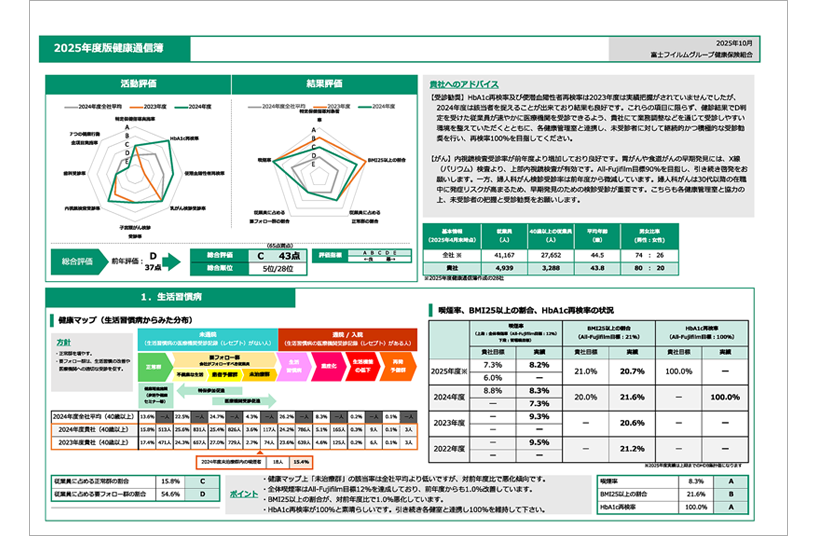
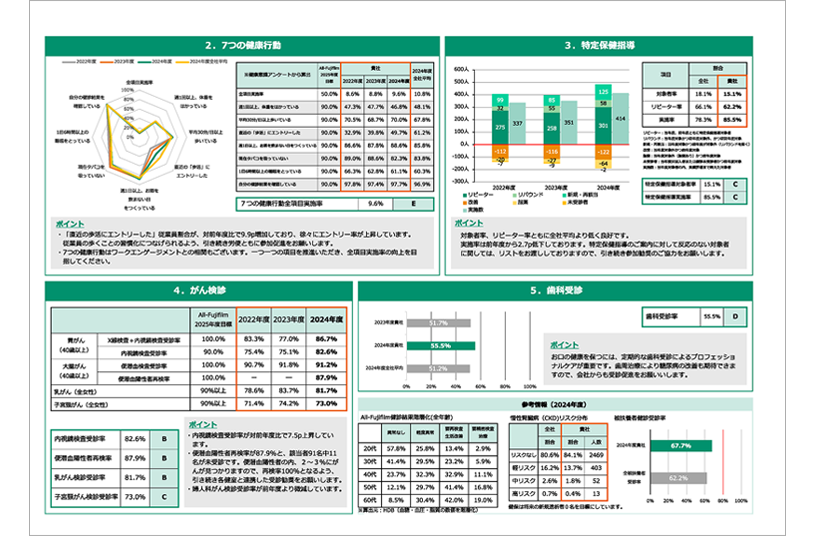
The Fujifilm Group Health Insurance Association collaborates with the Health Promotion Group, FUJIFILM Holdings Corporation, to facilitate understanding the health status of each domestic company from FY2016 by issuing a “Health Report” per company which summarizes and visualizes the data in numbers and graphs. For companies with high health risks, the department directly explains what that means to the management, thereby clarifying the health challenges each group company must address and reflecting them in their programs.
A female public health nurse provides advice to female employees based on consultations with in-house specialists.
We invited an outside gynecologist to hold a seminar titled “Female Health Seminar for Living to 100.” Under the theme “Women’s Health Management and Benefits to Society— Learn more about women’s body and health literacy," the gynecologist spoke on women’s health issues, health risks by age group, and tips for working happily while maintaining good health. The seminar was held twice, once at the Tokyo Mid Town Head Office and once at Yokohama Minatomirai Center, and a total of 160 employees participated. Responses to the survey of participants included comments such as “I learned the importance of confronting one’s mental and physical state”.
Material provided on the day of the seminar is posted on the in-house intranet.
We hosted an online seminar titled “The Importance of Breast Cancer Screening” by radiologist Dr. Tokiko Endo, who standardized mammography screening in Japan and is working to further improve the screening rate and accuracy.
Fujifilm’s mammography system developers explained the untold story behind its development. Around 450 group employees throughout Japan took part on the seminar.
The seminar was highly praised as can be seen in the responses to the survey of participants, which included comments such as “I gained an understanding of not only breast cancer but also the importance of undergoing screening,” “it was informative because of the doctor’s careful explanation,” “I learned about Fujifilm’s products,” and “I will recommend that family members and people I know undergo screening.”
The video is available to employees throughout Japan via the in-house intranet health portal site.
Seminar movies of breast cancer by company physicians are distributed to all employees of domestic group companies to improve their understanding of breast cancer and promote medical check-ups.
A webinar titled "Health Support Seminars for Working Women" was held with an external obstetrician-gynecologist/psychopractice physician. The lecture included two-way quiz questions with participants. The purpose of the lecture was to acquire the self-control technique and to raise the support power of the people around them to raise their performance by learning the mind and body of women. A total of 351 group employees (84 males, 24%) participated on the day. From the questionnaire of male participants, it was suggested that their understanding of the mind and body of women improved, such as “The words remained in their impression ; Half of the sheath is knowledgeable, and the reason of ignorance about the pain/suffering leads the action without delicacy” and “I once again felt that knowing about the mental and physical cycles of women is very important,” and “I would like other managers and colleagues to participate in the webinar”.
Understanding the various mental and physical disorders of life stages is important in maintaining and promoting one’s own health. In order to understand and deal with menopause, which is tend to be thought the problem only for women, and to understand that both men and young people are on the way, we conducted an e-learning program “Menopause Understanding and Self-Care” conducted by our company physician, a gynecologist, and 46,377 employees of group companies took the course.
The risk of women developing diseases varies depending on their age, and there are various risks of developing diseases at each stage of life. It is important to create an environment and atmosphere where female employees can feel comfortable talking to their superiors and colleagues, and for those being consulted to acquire the knowledge necessary to empathize with the concerns of female employees. We held an e-learning course for managers, “Understanding Women's Unique Diseases: Considering Future Responses,” taught by an occupational physician and gynecologist, and 9,400 managers from Group companies took the course.
Among women's health conditions, cervical cancer and breast cancer require particular attention from a young age. Acquiring the necessary knowledge is crucial for undergoing regular screenings and detecting bodily abnormalities early. Exclusively for female employees of group companies, we conducted an e-learning program titled “Essential Knowledge on Women's Health Conditions: Part 1 - Cervical Cancer and the HPV Vaccine,” delivered by an occupational physician who is also a gynecologist. A total of 11,300 employees participated. Moving forward, we plan to continue educational initiatives for female employees, selecting topics based on survey feedback.
At the Fujifilm Group, we are focusing on early detection and treatment as one priority area in cancer control measures and working to increase the gynecological cancer screening rate to 90% or more. By incorporating gynecological cancer screenings into regular health checkups and promoting awareness of the need to undergo such checkups, the screening rate has steadily increased across the Group. (The Fujifilm Group Health Insurance Society provides a subsidy of up to 8,000 yen per year for breast cancer and cervical cancer screenings, respectively).
Based on the results of the survey conducted after the first e-learning session and following consultation with a gynecologist (occupational physician), we launched the second session on the theme “Women’s Health Conditions You Should Know About—Part 2: Women’s Bone Health,” which was completed by 11,600 female employees. Participants deepened their understanding of bone health and learned about the importance of appropriate care tailored to their stage of life.
During the same period, with the goal of helping male employees gain a proper understanding of women’s health concerns and challenges—and thereby fostering workplace support and respect for diversity—we had 31,400 employees take the e-learning course “Understanding Women’s Health Issues: Considering Future Responses,” which had previously been offered to managers. We will continue to provide e-learning courses on topics relevant to each employee’s needs.
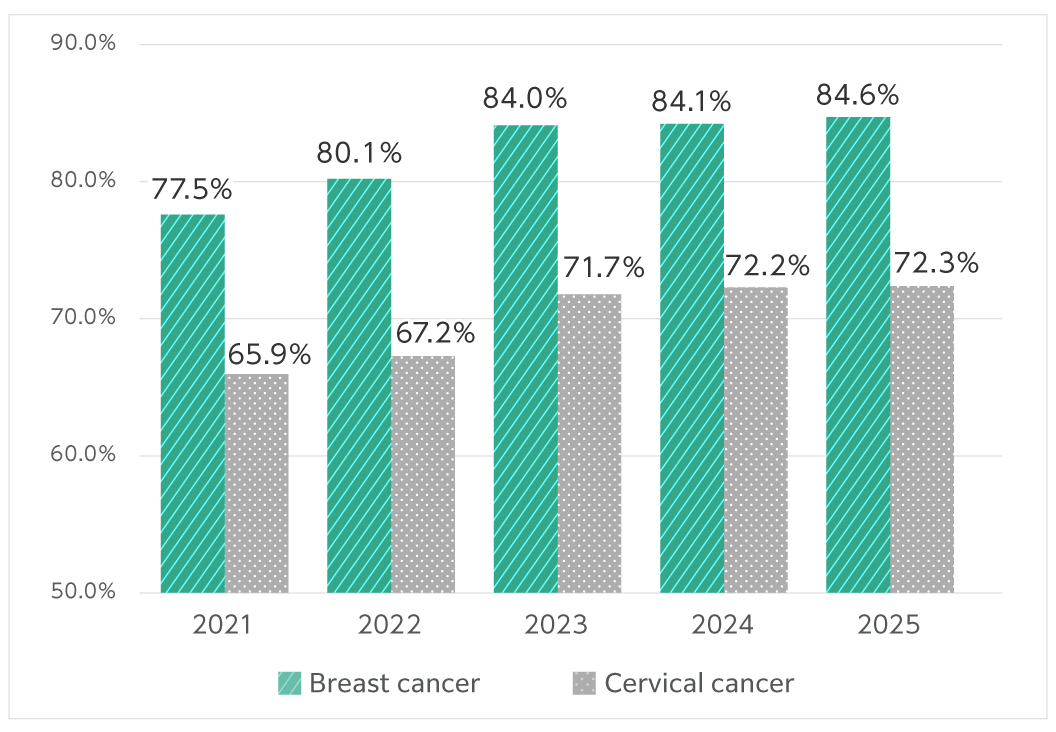
Group female employees in Japan
- * KENKO Investment for Health® is a registered trademark of Nonprofit Organization Kenkokeiei.