

April 1, 2026
FUJIFILM Holdings Corporation
We formulated and published the FUJIFILM Holdings Corporation Corporate Governance Guidelines (“Guidelines”), recognizing that corporate governance is an important management issue, as the fundamental basis for the FUJIFILM Group to achieve sustainable growth and increase its corporate value, and to contribute to the sustainable development of society. We have revised the Guidelines to reflect the Corporate Governance Code of the Tokyo Stock Exchange and our policy for strengthening corporate governance.
The Guidelines stipulate the roles and duties of the Board of Directors (“BoD”) as follows: (i) to decide on basic management policies, strategies, and important matters relating to business execution, and (ii) to supervise the execution of business. To ensure the effectiveness of the BoD, evaluations and hearing sessions, etc. are conducted by each Director and Audit & Supervisory Board Member, and after analysis, evaluation, and discussion of improvement measures at the BoD, we publish a summary of the results. For the purpose of securing transparency and objectivity, we periodically engage a third-party organization for part of the questionnaire creation and evaluation analysis.
We conducted an effectiveness evaluation of the BoD meetings held in 2025, and the results were reported and discussed at the BoD. The following is a summary of the evaluation results.
Evaluation to assess whether the BoD is fully performing to expectations, in light of its roles at our company.
We are organized as a Company with an Audit & Supervisory Board, and the BoD makes decisions on basic management policies, strategies, and important matters relating to business execution, as well as supervising the execution of business. In this context, it is important that the BoD fulfil the following two roles:
- The role of making decisions with a high-level of knowledge for each business and thorough understanding of the assets, such as technology and human resources, in line with the robust business portfolio that we have built to date.
- The role of ensuring that the orientation of execution of business aligns with the medium- and long-term values demanded by society, in order to balance economic and social value, with the aim of achieving a sustainable society.
| Subject of Evaluation | The BoD meetings held in CY2025 (all 12 that were held, and including written resolutions and written reports) |
|---|---|
| Evaluators | Directors and Audit & Supervisory Board Members (15 persons in total) |
| Method of Evaluation*1 | Questionnaire, individual interviews |
| Evaluation Items | Roles that the BoD should fulfil, composition of the BoD, quality of discussions, deliberations by the Nomination and Remuneration Advisory Committee, support system for Outside Officers, constructive dialogue with shareholders and investors, etc. |
- *1 A third-party organization was engaged to assist, in part, with the setting of evaluation items, creation of questionnaire questions, and analysis of questionnaire responses and interview results of each Director and Audit & Supervisory Board Member.
We evaluate that the BoD is fully performing the expected roles set forth above.
The details of the evaluation, the future issues identified, and our initiatives for 2026 are as shown in the following table.
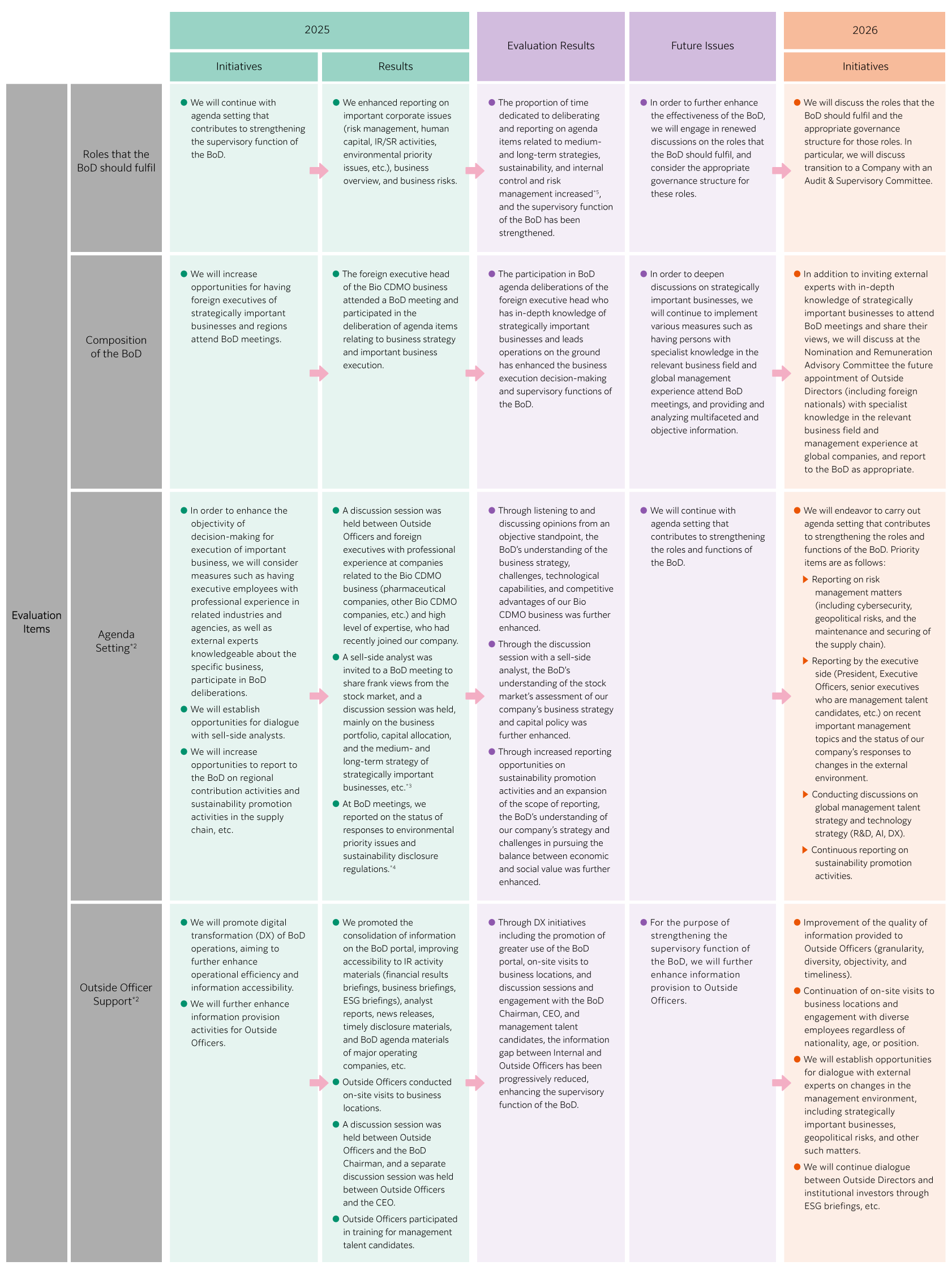
- *2 As part of this effectiveness evaluation, a review of the evaluation items was conducted, and the categories ‘Quality of Discussions’ and ‘Constructive Dialogue with Stakeholders’ were restructured into ‘Agenda Setting’ and ‘Outside Officer Support’. With this change, certain of the initiatives set at the beginning of the year were reallocated to the restructured evaluation items.
- *3 Conducted in January 2026
- *4 Conducted in March 2026
- *5 Analysis of Agenda Items: The percentages are based on the time spent on deliberations at the BoD.


- The Evaluation of the Effectiveness of the Board of Directors (April 1, 2025)
- The Evaluation of the Effectiveness of the Board of Directors (April 1, 2024)
- The Evaluation of the Effectiveness of the Board of Directors (April 1, 2023)
- The Evaluation of the Effectiveness of the Board of Directors (April 1, 2022)
- The Evaluation of the Effectiveness of the Board of Directors (April 1, 2021)
- The Evaluation of the Effectiveness of the Board of Directors (April 3, 2020)
- The Evaluation of the Effectiveness of the Board of Directors (April 5, 2019)
- The Evaluation of the Effectiveness of the Board of Directors (April 4, 2018)
- The Evaluation of the Effectiveness of the Board of Directors (April 17, 2017)
- The Evaluation of the Effectiveness of the Board of Directors (April 12, 2016)